On Lynx Africa: De-contextualising a Deodorant Body Spray and Examining the Imperial Gaze in Advertising
An essay on Lynx Africa, semiotics, and the imperial gaze in advertising.
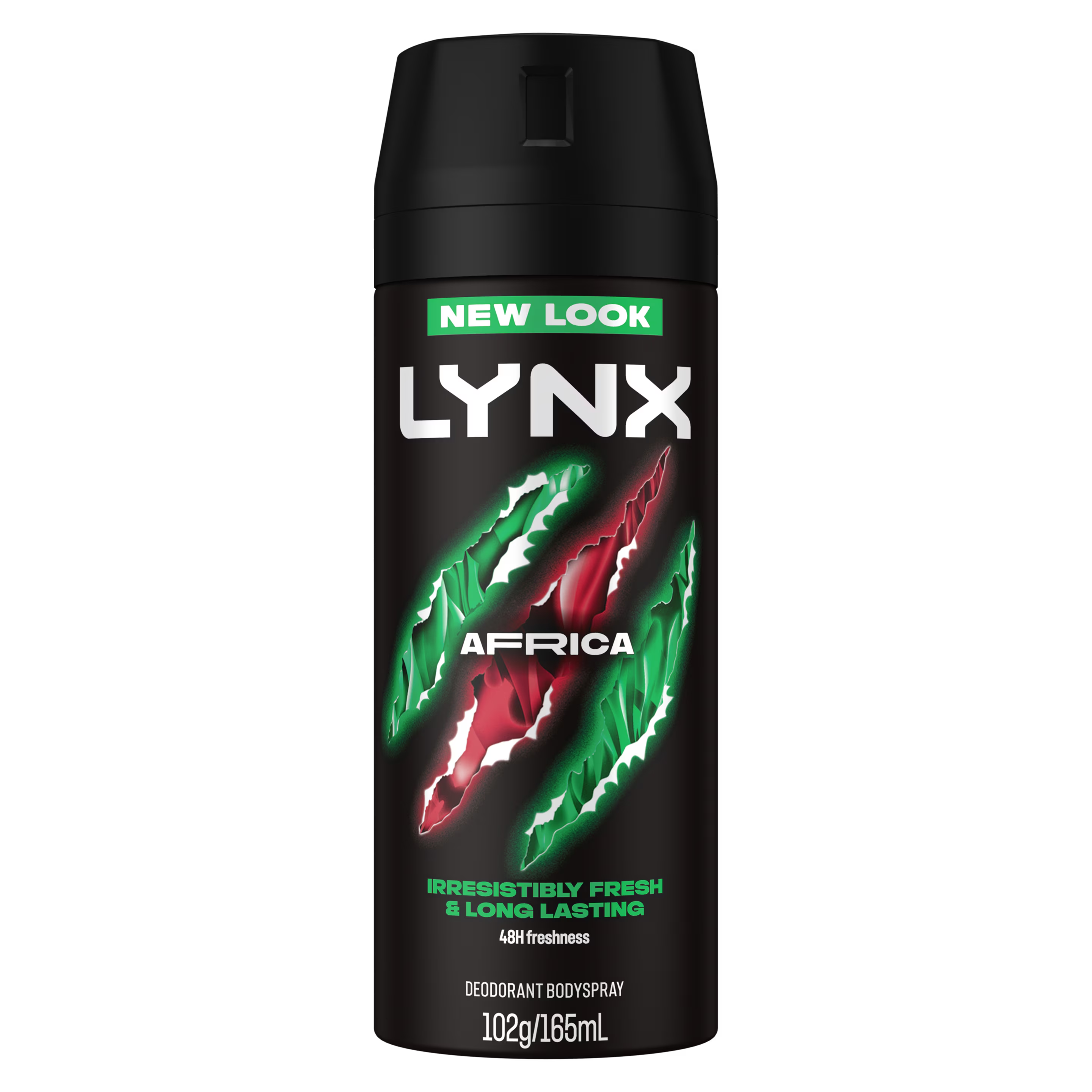
Lynx Africa is commonly found at the bottom of the bags of secondary-school children. As a child, I often wondered why they would call it Lynx Africa, but I couldn’t quite place my confusion. Some years have passed, and I now have the vocabulary to place it. The question that interested me then seems pretty simple: what exactly is African about Lynx Africa?
The first useful word in this new vocabulary is ‘signifier’. In the semiotic model developed from Ferdinand de Saussure and subsequently expanded by Roland Barthes, the signifier is the perceptible component of a sign: a written or spoken word, image, sound or object. The ‘signified’ is the concept that this form evokes. Together they constitute the ‘sign’.
Consider the presentation of a bouquet of flowers. The flowers operate as a signifier, while affection, gratitude, romance or sympathy might constitute the signified. Through repeated cultural association, the bouquet becomes a kind of semantic shorthand. It is possible to communicate something without stating it explicitly.
One might imagine someone being confused when presented with a handful of pebbles from the beach at a special occasion, say a birthday. This is because the pebbles do not signify a particular feeling and therefore do not carry the same semantic weight. If however in an in group the celebrant has an emotional attachment to a previous birthday spent at the beach then the semantic weight of the gesture is restore but only in the context of that particular in group. Meaning is therefore neither intrinsic nor inevitable. It is produced through systems of association.
This distinction becomes more complicated in Barthes’s Mythologies. Myth operates as a second-order semiological system. An already constituted sign can itself become the signifier for another system of meaning. Historical associations can consequently acquire the appearance of being natural. Myth does not simply communicate an idea; it obscures the process through which that idea came to appear self-evident.
It is here that Lynx Africa becomes interesting.
It is a commodity that exposes how we think about things that are seemingly unrelated. Lynx Africa as a signifier is semantically coherent (at least somewhat). So it follows that it signifies something that is intelligible. Meaning it communicates something to the consumer that a hypothetical product like Lynx Europe or Lynx Midlands may not.
“Africa” denotes a continent. Yet within Western consumer culture it also carries a dense accumulation of secondary associations: heat, wilderness, nature, danger, sensuality, authenticity, instinct, vitality and exoticism. These associations are not inevitable or geographically coherent.
They are culturally produced. Nevertheless, they have become sufficiently familiar that “Africa” can be placed on the side of a deodorant can and appear to describe something.
Again, a hypothetical product called Lynx Europe immediately exposes the peculiarity. Lynx Midlands is stranger still. Further still, Lynx Harpurhey begins to sound like a joke. Yet Lynx Africa has circulated for decades without its geographical designation generally appearing absurd. The difference is revealing. “Africa” has acquired sufficient mythological coherence within Western culture.
For this to work, however, Africa must first become less specific.
As with the example concerning the bouquet of flowers, the marketer and the consumer must enter a sort of social and linguistic contract in which Africa must be stripped of nuance and identity outside choice adjectives, in order for the signifier to hold semantic weight. Without the social contract in place the signifier is unintelligible.
Africa is therefore reduced to a series of shorthands that allow the continent to remain legible as the site of wildness and the Savannah.
The continent must be partially emptied of its historical and geographical complexity and reconstructed as a manageable collection of signs. Fifty-four internationally recognised sovereign states, thousands of languages, enormous cities, deserts, rainforests, financial districts, nightclubs, suburbs and radically different political and cultural histories become subordinate to a much smaller vocabulary: heat, wilderness, instinct, vitality.
The extraordinary heterogeneity of a continent becomes commercially inconvenient. Myth resolves the problem.
Africa becomes legible.
The packaging of Lynx Africa participates in this process without needing to represent any particular African place. Depending upon the iteration of the packaging, black surfaces are interrupted by red, green and white graphic elements, sometimes rendered with jagged or claw-like forms as if piercing the bottle viscerally and frenetically. The word AFRICA appears prominently. Yet there is no country, city, person or identifiable landscape. Indeed, very little geographical information is required.
This absence is important. The packaging does not need to show Africa because “Africa” has already been pictured culturally.
A useful exercise is therefore to temporarily refuse the mythology and describe the commodity as though its cultural meaning were unknown.
The composition contains:
- A vertically oriented cylindrical container;
- A predominantly black exterior surface;
- A black cylindrical cap occupying approximately the upper quarter of the object;
- A horizontal seam separating the cap from the main body;
- A small green rectangular field containing the words “NEW LOOK”;
- The word “LYNX” printed in large white uppercase lettering;
- Three irregular diagonal graphic forms extending across the central portion of the container;
- Areas of green, red, white and black;
- Uneven and pointed edges within portions of these graphic forms;
- The word “AFRICA” printed in white uppercase lettering;
- Six letters comprising the word “AFRICA”;
- No additional geographical information accompanying the word “AFRICA”;
- No map visible on the container;
- No country names visible on the container;
- No human figures visible on the container;
- No landscape visible on the container;
- No identifiable flora or fauna visible on the container;
- No representation of the African continent visible on the container;
- The words “IRRESISTIBLY FRESH & LONG LASTING”;
- The words “48h freshness”;
- The words “Deodorant Body Spray”;
- No visible contents;
- No visible indication of the colour of the substance contained within;
- No visible indication of the mechanism by which the word “AFRICA” relates to the substance contained within;
- No visible indication of a specific geographical location corresponding to the word “AFRICA”;
- No visible explanation of the criteria by which the substance has been designated “AFRICA.”
Once the cultural associations normally supplied to the object are withheld, there is nothing materially present on the container that explains why a chemical aerosol should have the name of a continent. “Africa” becomes intelligible only when the mythology surrounding the term is restored.
De-contextualisation therefore makes visible, that which familiarity conceals.
This also reveals an important distinction between representation and reference. Lynx Africa does not need to represent a real African location because, increasingly, it does not need to refer to one at all.
Here Jean Baudrillard becomes extremely useful.
For Baudrillard, the simulacrum describes a condition in which signs cease merely to represent any tangible reality and instead circulate through relationships with other signs. In other words signs that reference other signs rather than an actual signifier in a recursive loop.
A way to visualise this that I have found helpful is to imagine a blueberry a fairly innocuous fruit. The blueberry is something that exists in real life. It becomes more complicated when we introduce the idea of blueberry flavour bubble gum. The idea becomes more complicated still when we introduce blueberry bubble gum scented car freshener. And finally ending with the absurd blueberry bubble gum scented car freshener as scent for washing detergent. The signifier of the initial blueberry becomes so far removed that the final signified that it is semantically unrecognisable.
The distinction between representation and reality becomes increasingly unstable.
The “Africa” of Lynx Africa can be approached in these terms. Where exactly is it?
It is not Nigeria, Algeria, Senegal, Ethiopia or South Africa. It is not Lagos, Nairobi, Dakar, Johannesburg or Cairo. Nor is it simply the savannah, rainforest or desert. Attempting to locate it geographically misunderstands its function. Lynx Africa’s Africa exists primarily within a circulating network of signs: heat refers to passion, wilderness to instinct, animals to virility, red to heat and desire, and “Africa” gathers these associations beneath a single commercially legible name.
The referent begins to disappear.
What remains is an Africa assembled from previous representations of Africa. Advertising borrows from cinema, tourism, colonial imagery, adventure narratives and other advertisements. These representations reinforce one another until the simulated Africa becomes capable of circulating without requiring confirmation from the continent it ostensibly names.
In this sense, Lynx Africa does not merely stereotype Africa. It participates in an “Africa” that has become partially simulacral: a sign referring increasingly to an accumulated archive of other signs. Like the blueberry, no longer referring to the original signifier.
This is also why Lynx Europe feels different. Europe has certainly been mythologised, but within British consumer culture “Europe” does not ordinarily function as an equivalent reservoir of undifferentiated primitive vitality. Paris, Berlin, Manchester, Rome and Leeds resist collapsing quite so effortlessly into a single smell. The absurdity becomes immediately perceptible.
Lynx Harpurhey makes the mechanism even more conspicuous. Its specificity demands questions. Which street? Which building? Which people? What makes this smell Harpurhey? The smaller geography becomes difficult to abstract without the abstraction appearing comic. “Africa,” paradoxically, can be made less geographically specific despite being vastly larger.
This flattening has a history.
European representations of colonised and non-European territories have frequently constructed distant geographies as spaces onto which desires and anxieties can be projected. Edward Said’s account of Orientalism demonstrates how the imagined Other is produced relationally: the supposedly irrational, sensual, timeless or exotic elsewhere helps establish the West as rational, modern and ordered. Although Said’s principal geographical concern is not sub-Saharan Africa, the representational mechanism has clear resonances with European constructions of Africa. Writers such as V. Y. Mudimbe have more specifically examined how Western systems of knowledge participated in producing “Africa” as an intelligible conceptual object.
Anne McClintock’s analysis of imperialism and commodity culture is especially pertinent because colonial fantasy did not remain confined to maps, museums or explicitly political propaganda. It entered domestic life through commodities, packaging, soap and advertising. Empire could consequently become ordinary: encountered through objects used to clean and regulate the body rather explicit political doctrine.
This history makes deodorant an unexpectedly appropriate object through which to examine the imperial gaze.
There is also something inherently funny about Lynx Africa.
Deodorant is a technology of hygiene. It exists precisely because the human body is considered capable of producing smells that modern social conventions ask us to regulate. It is industrially manufactured, chemically formulated, mechanically aerosolised, branded, packaged, shipped through global supply chains and sold in supermarkets.
And yet this extraordinarily manufactured object promises access to something supposedly primal.
The contradiction is almost perfect.
One sprays oneself with a carefully constructed industrial hygiene product in order to signify instinct. Ha!
Civilisation is used to manufacture the fantasy of escaping civilisation.
The humour is not incidental. It exposes the structure of the commodity. The consumer is not being offered wilderness but a hygienically controlled simulation of wilderness that can safely be purchased, sprayed onto the body and washed off later.
This contradiction becomes particularly significant because Lynx has historically marketed itself through masculinity and sexual desirability. The brand’s promise has often involved transformation: the application of the product supposedly alters the wearer’s erotic visibility. “Africa” can therefore be incorporated into a chain of associations in which nature becomes wildness, wildness becomes instinct, instinct becomes virility, and virility becomes masculine sexual desirability.
The imperial and gendered dimensions of the commodity converge here.
The Western consumer spays the product, applying and imagined elsewhere to himself.
Africa becomes a purchasable attribute.
This suggests a particular form of imperial gaze. The gaze need not always involve a literal image of a colonised subject being looked upon. Rather, it can operate through the symbolic availability of geography itself. A distant and heterogeneous continent is rendered sufficiently coherent to be named, packaged and consumed. Its imagined qualities can be detached from people and places and made available as properties of a commodity.
The relationship is therefore is one of possession.
The consumer does not travel to Africa. “Africa” travels to the consumer, compressed into a 165 mL aerosol container.
Or, more precisely, something called Africa does.
A possible objection is that this analysis grants too much significance to a banal product name. A contemporary British teenager spraying Lynx Africa after PE is unlikely to be consciously contemplating colonial fantasy, exoticism or the construction of the Other. For many consumers, “Africa” may signify nothing more complicated than a familiar Lynx fragrance.
Yet this objection may inadvertently demonstrate Barthes’s point.
Myth does not require the consumer consciously to rehearse its history. Its effectiveness depends partly upon that history disappearing. The association appears ordinary precisely because the cultural labour required to produce it has been forgotten. One might imagine a 12 year-old boy in a western country associating the word Africa with the Unilever scent before the vast continent.
The question is why the name Lynx Africa can appear immediately intelligible when Lynx Europe, Lynx Midlands or Lynx Harpurhey draws attention to itself as strange.
There is even the possibility that, after decades of circulation, the relationship has become recursive. Lynx Africa no longer merely borrows meaning from existing representations of Africa. It may itself contribute to them. For a British child encountering the word through commodities, television, packaging and advertising, Lynx Africa becomes one of countless cultural objects through which “Africa” is learned.
The sign begins to refer to the sign.
Barthes and Baudrillard therefore illuminate different stages of the same process. Barthes helps explain how history is transformed into nature: how particular cultural associations become attached to “Africa” until they appear self-evident.
Baudrillard allows the analysis to proceed further, towards a condition in which the resulting “Africa” circulates increasingly independently of geographical Africa. One explains naturalisation; the other helps describe the strange autonomy subsequently acquired by the sign.
This returns me to the confusion I experienced as a child.
I knew that Lynx Africa made sense. I also sensed that it should not.
Maybe that contradiction is precisely what makes the object useful. The deodorant can is unremarkable enough to disappear into the bottom of a school bag, yet it contains an unexpectedly elaborate system of signs. A continent becomes a word; the word becomes a mythology; the mythology becomes a smell; the smell becomes a commodity; and the commodity is sprayed onto the body as a promise of sexual vitality.
Nothing on the container explains why any of this should make sense.
And that’s probably the point.